
Do you experience recurring injuries when running? Notice that you walk differently on one side? Or wonder whether the way you move is contributing to your knee, hip or ankle pain?
The way we walk and run can provide valuable information about how our bodies move, absorb load and adapt to different activities.
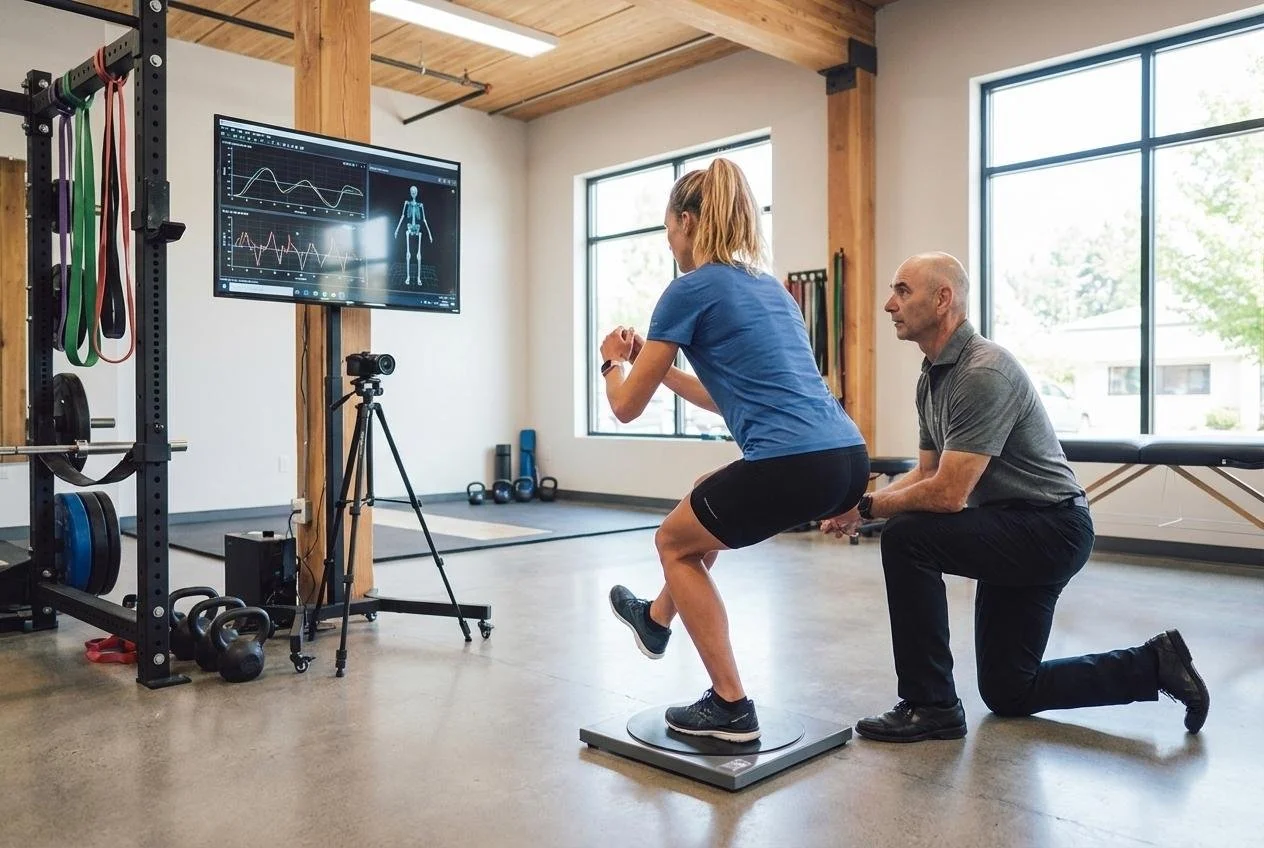
Gait analysis allows physiotherapists to assess movement patterns, identify potential contributing factors to pain and develop a more targeted rehabilitation programme.
But gait analysis isn't simply about finding something wrong with the way you walk or run.
At The Body Lab Physio in Ranelagh, Dublin, we believe movement should be assessed in the context of the individual, their symptoms and their goals.
The aim isn't to achieve a supposedly perfect walking or running technique. It's to understand how you move and whether changing certain aspects of your movement could help you feel and perform better.
What Is Gait Analysis?
Gait analysis is the assessment of how a person walks or runs.
It involves observing movement patterns and examining how different parts of the body work together during each step.
During walking and running, your muscles, joints and nervous system coordinate to move your body forward while managing the forces passing through your lower limbs.
Gait analysis may examine:
Foot and ankle movement
Knee alignment and control
Hip and pelvic movement
Trunk posture and rotation
Step length and walking or running cadence
Differences between the left and right sides
How your body absorbs and generates force
Depending on the assessment, physiotherapists may use visual observation, video recordings or other movement analysis tools to examine your gait in greater detail.
The goal is to understand your movement patterns and determine whether they are relevant to your symptoms or performance.
Who Can Benefit From Gait Analysis?
Gait analysis isn't just for professional athletes.
It can be useful for anyone experiencing movement-related pain, recurring injuries or difficulty walking or running comfortably.
1. Runners With Recurring Injuries
Running places repeated demands on the muscles, joints and tendons of the lower limbs.
If you're experiencing persistent or recurring pain, gait analysis may help identify movement characteristics that could be contributing to how your body is being loaded.
Common running-related conditions include:
Patellofemoral pain (runner's knee)
Achilles tendinopathy
Plantar heel pain
Medial tibial stress syndrome (shin splints)
Iliotibial band-related pain
Hip and gluteal tendon pain
However, it's important to remember that running injuries are rarely caused by one movement pattern alone.
Training load, strength, recovery, previous injuries and individual tissue capacity also play significant roles.
2. People Experiencing Knee, Hip or Ankle Pain
Gait analysis may help us understand how you distribute load through your lower limbs during walking.
For example, someone with knee pain may unconsciously reduce the amount of time they spend on the painful leg.
Another person may alter their stride length or walking speed to avoid discomfort.
These changes are often natural responses to pain rather than faulty movement patterns.
Understanding them can help guide rehabilitation.
3. People Recovering From Injury or Surgery
After an injury or operation, walking patterns can change.
You may develop a limp, avoid putting weight through one leg or struggle to regain your previous walking speed.
Gait assessment can help identify functional limitations and monitor improvements as rehabilitation progresses.
4. Runners Looking to Improve Performance
Gait analysis can also be useful for runners who want to understand their running technique.
Factors such as cadence, stride length and foot placement can influence how forces are distributed through the body.
In selected cases, adjusting these variables may help improve running comfort or efficiency.
However, there is no single running style that is ideal for everyone.
What Happens During a Gait Analysis Assessment?
A useful gait assessment involves much more than simply watching someone walk or run.
At The Body Lab, our physiotherapy approach focuses on understanding the relationship between your symptoms, movement patterns, physical capacity and activity demands.
A gait-focused assessment may include the following.
1. Understanding Your Symptoms and Activity History
We begin by discussing your symptoms and what you want to achieve.
This may include:
Where and when you experience pain
Your walking or running habits
Recent changes in training volume or intensity
Previous injuries
Footwear and activity preferences
Your rehabilitation or performance goals
This information is essential because movement patterns only become clinically meaningful when considered alongside your individual circumstances.
2. Walking or Running Assessment
We observe how you move at a comfortable pace and, where appropriate, at different speeds.
Depending on your needs and the equipment available, this may involve walking or running on a treadmill or overground.
We may assess:
Stride length and step width
Walking or running cadence
Foot placement
Knee and hip movement
Pelvic and trunk control
Left-to-right differences
Video analysis may be used when appropriate to review movements in more detail.
Importantly, an asymmetry or unusual-looking movement does not automatically indicate a problem.
Some movement variation is completely normal.
3. Strength and Mobility Assessment
Gait analysis becomes more useful when combined with a physical examination.
We may assess:
Calf strength and endurance
Hip and gluteal strength
Ankle mobility
Single-leg balance
Functional movement control
Hopping or other impact-related tasks, when appropriate
For example, a runner experiencing Achilles tendon pain may demonstrate reduced calf strength or difficulty tolerating repeated single-leg loading.
In this situation, strengthening the calf complex may be more beneficial than trying to change foot strike.
4. Developing an Individualised Plan
Once we've identified the factors most relevant to your symptoms, we develop a plan based on your needs.
This may involve progressive strengthening, mobility exercises, changes to training load or selected gait modifications.
The aim is to address meaningful limitations rather than correcting every visible movement variation.
Can Gait Analysis Help Prevent Running Injuries?
This is one of the most common questions surrounding gait analysis.
The answer is more complicated than simply identifying poor running technique.
There is currently limited evidence that routine gait analysis or changing running technique in otherwise healthy runners can reliably prevent future injuries.
Running injuries are multifactorial.
Factors such as sudden increases in training volume, insufficient recovery, reduced strength and previous injury history may all influence injury risk.
However, gait analysis can still be valuable when used to investigate an existing problem and guide targeted rehabilitation.
The goal isn't to create a perfect running pattern. It's to help your body tolerate the demands of running.
Should You Change Your Running Technique?
Not necessarily.
There is no single correct way to run.
Some runners naturally land on their heels, while others land more towards the middle or front of the foot.
Neither pattern is automatically wrong.
Changing your running technique without a clear reason can sometimes shift stress from one area of the body to another.
For example, moving towards a forefoot strike may reduce certain loads around the knee while increasing demand on the calf muscles and Achilles tendon.
For someone already experiencing Achilles pain, this may not be an appropriate change.
Gait retraining should therefore be based on an individual assessment rather than general rules.
What Is Gait Retraining?
Gait retraining involves deliberately modifying certain aspects of walking or running technique.
It may be considered when a particular movement characteristic appears to be contributing to symptoms.
Examples include:
Increasing Running Cadence
A modest increase in step rate may reduce overstriding and alter loading around the knee and hip in some runners.
Adjusting Stride Length
Shortening an excessively long stride may help some individuals manage running-related discomfort.
Improving Movement Control
Targeted strengthening and movement exercises may help improve how a person manages load during functional activities.
Gradually Restoring Normal Walking
Following an injury or surgery, gait retraining may focus on improving weight-bearing confidence, walking speed and symmetry.
These changes are introduced gradually and monitored to ensure they are actually beneficial.
Not everyone needs gait retraining, and it shouldn't replace an appropriate strengthening or rehabilitation programme.
Does Foot Pronation Mean You Need Orthotics?
Foot pronation is a normal part of walking and running.
It allows the foot to adapt to the ground and helps manage forces during movement.
Having flat feet or a pronated foot position doesn't automatically mean you have a biomechanical problem.
Similarly, not everyone with foot pain needs orthotics.
Footwear changes or orthoses may be useful for certain individuals and conditions, but they should be considered in the context of symptoms, comfort and clinical findings.
At The Body Lab, we focus on understanding whether a particular foot movement is actually relevant to your problem before recommending changes.
Can Gait Analysis Help With Achilles Tendon Pain?
Yes, it can be a useful part of the assessment for some people with Achilles tendinopathy.
Running places considerable demands on the Achilles tendon, particularly during faster running, hill training and repeated push-off movements.
Gait analysis may help identify factors that influence how the tendon is loaded.
However, gait modification alone is unlikely to resolve Achilles tendinopathy.
Progressive calf strengthening, appropriate training-load management and gradual return to running remain central to rehabilitation.
Gait analysis can help guide the process, but it is only one part of the overall treatment plan.
Do You Need Gait Analysis if You Don't Have Pain?
Not everyone needs a formal gait assessment.
If you're walking or running comfortably, progressing well with training and not experiencing any problems, there may be no reason to change your technique.
However, an assessment may be useful if you have specific performance goals, concerns about movement or a history of recurring injuries.
The most important question is whether the information gained will help you make a meaningful improvement.
Gait Analysis and Physiotherapy in Ranelagh, Dublin
Whether you're recovering from an injury, dealing with recurring running pain or struggling to walk comfortably, understanding how you move can be an important part of rehabilitation.
At The Body Lab Physio, we take an individualised approach to movement assessment and treatment.
We look beyond isolated movement patterns to consider your strength, mobility, activity levels, symptoms and goals.
Where appropriate, gait assessment can help us identify relevant movement characteristics and guide your rehabilitation.
No chasing perfect posture. No unnecessary changes to your running style. Just a practical, evidence-informed approach to understanding movement and improving function.
Struggling with recurring running injuries or pain when walking?
Book a physiotherapy assessment at The Body Lab and let us help you understand your movement and build a plan to get back to the activities you enjoy.
The Body Lab Physio
Ranelagh, Dublin 6
The science of physiotherapy. The craft of recovery.
